The AI Automation Engine: Building Custom GPTs
to Scale Customer
Service & Sales
(How much you’ll actually save by automating processes)
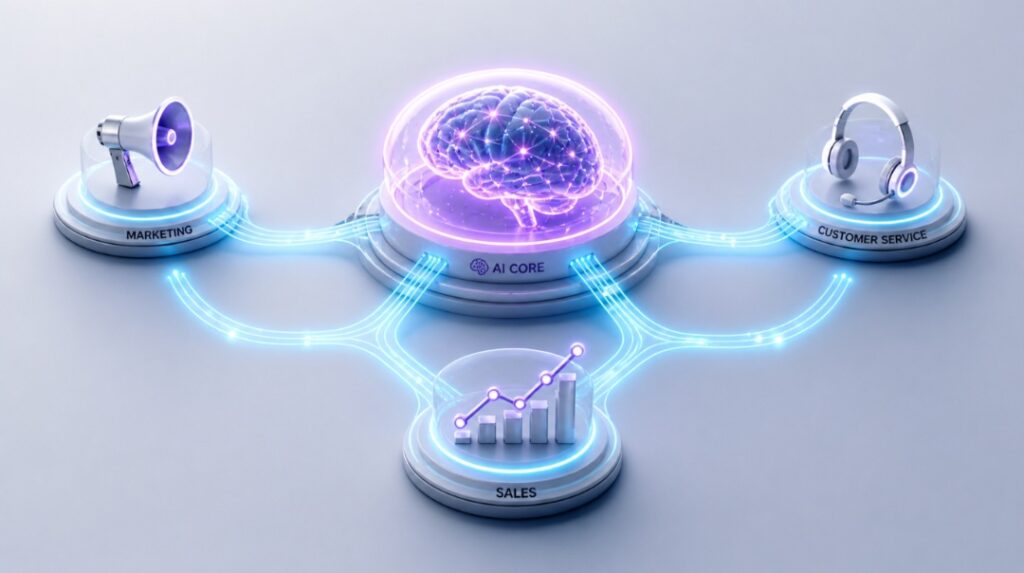
The AI Automation Paradigm: Why Custom Agents Are the New Revenue Engine
For years, the promise of “AI for business” was trapped in a cycle of frustration: generic, rule-based chatbots that broke the moment a customer asked a non-standard question. These off-the-shelf tools were designed for efficiency, but they often came at the cost of the customer experience. In 2026, the paradigm has shifted. We have moved past the era of static scripts and into the age of Intelligent Automation, where Custom AI Agents act as digital employees, capable of understanding nuance, recalling deep business SOPs, and executing complex sales workflows with surgical precision.
A Custom AI Agent is not merely a tool for FAQ deflection; it is a scalable, 24/7 revenue driver. Unlike standard chatbots that operate in a vacuum, these agents are integrated directly into your business architecture—connected to your CRM, your internal knowledge base, and your sales pipeline. They don’t just “talk”; they qualify leads, handle objections, and nurture prospects through the funnel, all while maintaining your unique brand voice.
At Finloxa, we view AI not as a cost-cutting measure, but as a strategic asset. By replacing manual friction with automated intelligence, you are creating a system that learns, scales, and delivers consistent results without needing human oversight. In this guide, we will break down the blueprint for building an AI agent that doesn’t just manage your customer service—it grows your business.
Automation Roadmap
01. Business Friction Mapping
Finding the “Automation Sweet Spot”
The biggest mistake businesses make when adopting AI is trying to automate everything at once. This leads to bloated systems that are prone to failure. In the US market, efficiency is not about doing everything; it is about eliminating the “high-cost, low-value” friction points that drain your team’s bandwidth.
To find your “Automation Sweet Spot,” you must audit your customer journey for repetitive, logic-based tasks. Where is your team losing the most time? Is it qualifying incoming leads? Is it answering the same shipping questions for the 100th time this week? Or is it manually syncing data between your CRM and your inbox? Map these points of friction. Your goal is to identify tasks that follow a predictable logic but consume human mental energy. Once identified, these tasks become the perfect candidates for your Custom AI Agent. By automating these “boring” but essential processes, you don’t just save money on labor costs—you free up your human talent to focus on high-level strategy, relationship building, and complex problem-solving. In the USA, time is the ultimate currency; don’t spend it on manual data entry when a custom AI can do it with 100% accuracy, 24/7.
02. AI Architecture
The Robust, Non-n8n Path
When scaling an agency or a business operation, you need an architecture that is bulletproof. Relying on complex, third-party automation tools like n8n can often create a “single point of failure”—if one node breaks, your entire pipeline goes dark. For high-ticket USA clients, downtime equals lost revenue.
To build a robust, scalable architecture, move toward Native and Serverless Integrations. This means leveraging API-first approaches where your AI agent talks directly to your CRM (like HubSpot or Salesforce) or your database via clean, lightweight serverless functions (like AWS Lambda or custom Python scripts). This “Non-n8n” path offers three distinct advantages: Latency, Reliability, and Data Security. By removing the middleware, you reduce the number of points where a process can fail. You also gain complete control over your data flow, which is a major compliance requirement for many US-based enterprise clients. Whether you are using OpenAI’s API, Anthropic, or open-source models, your architecture should be lean. A lean, direct-integration setup is not only faster but significantly easier to debug and maintain as your business scales. You are building a system that handles thousands of requests a minute; it needs to be as efficient as the code it runs on.
03. Intelligence Feeds
Building a Deep Knowledge Base
An AI agent is only as smart as the data it is fed. In the industry, we call this Retrieval-Augmented Generation (RAG). Many businesses simply “prompt” their AI to be helpful; that is not enough for a business-grade agent. To make your AI truly effective, you must turn your company’s internal documentation into a “Deep Knowledge Base.”
This involves cleaning and structuring your data—your PDF whitepapers, past customer email threads, technical SOPs, and even your brand guidelines—and vectorizing them. When a customer asks a question, your AI doesn’t just guess; it “queries” your proprietary data, retrieves the exact context, and provides an answer grounded in your business reality. This eliminates hallucinations (AI making things up) and ensures your brand voice is consistent across every interaction. For a US-based client, trust is everything. An AI that provides inaccurate or “made-up” information can destroy a brand’s reputation in seconds. By grounding your agent in a verified, deep knowledge base, you provide a level of expertise that mimics your top-performing human support agent. You aren’t just selling a chatbot; you are deploying your collective business intelligence across every single customer touchpoint, 24 hours a day.
04. Integration & ROI
Measuring Performance & Scalability
Automation without integration is just a fancy science project. The true value of an AI agent is unlocked when it acts as a “Closed-Loop” system. A successful agent doesn’t just answer questions—it takes action within your ecosystem. It should be able to update a lead’s status in your CRM, trigger a discount code, or even schedule a high-ticket demo call directly on your calendar.
To measure performance, you must move beyond vanity metrics like “Total Conversations.” Focus on Actionable ROI Metrics:
. Lead Conversion Rate: Is the AI moving prospects from “Visitor” to “Qualified Lead”?
. Resolution Velocity: How much faster is your AI resolving tickets compared to your previous manual processes?
. Cost-per-Interaction: What is the actual dollar amount you are saving per lead versus a human agent?
In the USA, everything is data-driven. If you can show a client that your system has reduced their response time from 4 hours to 4 seconds while simultaneously increasing lead conversion by 15%, you are no longer a “vendor.” You are an essential business partner. Building this integration isn’t just about code; it’s about engineering a feedback loop that continually makes your agent, and by extension your entire business, more profitable every single day.
The Custom AI Deployment Protocol
The secret to a successful deployment in the USA market isn’t the AI’s intelligence; it’s the Human-in-the-Loop (HITL) testing. Even the most sophisticated AI requires a calibration period. In the initial rollout, don’t give the agent full autonomous access to client-facing communication. Instead, run the agent in “Shadow Mode”—where it generates responses for your human team to approve.
This accomplishes two things: First, it allows the AI to learn from your team’s top-performing responses, effectively cloning the expertise of your best employees. Second, it builds internal confidence in the system. When your team sees the AI consistently producing high-quality responses, they stop fearing “replacement” and start treating the AI as their most efficient junior associate.
Finally, remember that in the US, compliance (GDPR, CCPA) is not optional. When building your integration, ensure that no personally identifiable information (PII) is stored in the AI’s training cache. Use transient memory where possible. A secure system is not just a technical necessity—it is your most potent selling point when pitching this automation to high-ticket USA clients who are hyper-protective of their data.
| Feature | Legacy Chatbot | Custom AI Agent |
|---|---|---|
| Logic Type | Static, Rule-Based | Dynamic, Generative |
| Context | None (Repeats) | Deep RAG Retrieval |
| Actionability | Message only | Full CRM Execution |
Why the Custom AI Advantage Wins:
The primary benefit of a Custom AI Agent lies in its ability to contextualize. A legacy chatbot treats every interaction as a fresh start, often forcing customers into frustrating, circular loops. In contrast, your Custom AI uses RAG (Retrieval-Augmented Generation) to access your entire history of SOPs, product data, and customer interaction history. This allows it to handle complex, high-intent queries that previously required a human manager.
For USA-based businesses, this means operational leverage. You are no longer hiring support staff to handle repetitive volume; you are hiring them to manage the intelligence that handles the volume. This reduces your overhead while drastically increasing your response speed, which is the single most important metric for capturing leads in a competitive market. Ultimately, the transition to Custom AI is a transition from high-friction support to low-friction revenue generation.
Ready to Build Your 24/7 Sales Agent?
Stop losing leads to slow response times. Let’s map your business processes and deploy a custom AI Agent that qualifies your leads and books demos on autopilot.
Zero-pressure consultation. See our recent Agent deployments →
AI Automation: FAQs
Technical and strategic answers for scaling your operations.
Q. How do Custom AI Agents differ from standard ChatGPT?
Standard ChatGPT is a general-purpose model. A Custom AI Agent is “grounded” in your specific business data via RAG (Retrieval-Augmented Generation). It doesn’t just chat; it executes workflows, accesses your proprietary SOPs, and adheres to your specific brand guardrails, making it an operational tool rather than a novelty.
Q. Can an AI Agent replace my human support team?
AI Agents are designed to augment, not replace. They handle high-volume, repetitive inquiries with 4-second response times, freeing your human experts to manage high-context, high-emotion client relationships. This increases your team’s capacity for revenue-generating work by 5x-10x.
Q. Is my business data secure with Custom AI?
Security is our architectural priority. By using enterprise-grade API integrations and transient memory protocols, your data is never used to train public models. We design our agents to operate within strict compliance frameworks (CCPA/GDPR), ensuring your business intelligence remains strictly private.
Q. How long does it take to deploy a functional agent?
A basic deployment can be live within 1–2 weeks, depending on the complexity of your data and integration requirements. The goal is a “lean launch”—deploying the core lead-qualification agent first, then layering on advanced support capabilities based on real-world interaction data.
The Future of Your Digital Operations
Automation is no longer a luxury reserved for tech giants; it is the baseline for sustainable growth in the 2026 digital economy. By moving from static, broken chatbots to custom-built AI Agents, you are not just improving response times—you are engineering a high-leverage engine that qualifies leads, nurtures prospects, and closes deals while you sleep. The market rewards those who prioritize speed and personalized precision. Your competitors are likely still relying on manual friction and generic scripts; you now possess the blueprint to outperform them through intelligent, grounded AI architecture.
The technology is ready. The systems are proven. The only remaining variable is your execution. Audit your current bottlenecks, secure your data pipeline, and deploy your first custom agent to reclaim your time. Stop managing tasks—start managing the intelligence that does the heavy lifting for you. Your scale begins with the systems you build today.
Finloxa AI Intelligence | 2026 Operational Scaling Protocol
Finloxa AI Architecture Desk
Verified 2026 Operational Protocol
The Finloxa AI Architecture Desk is a specialized task force focused on the intersection of generative intelligence and high-volume business operations. We move beyond “AI hype,” focusing on the engineering of RAG pipelines, API-first integrations, and serverless logic flows that serve USA-based businesses. Our protocols are developed through rigorous stress-testing of AI agents in live sales environments. We don’t just teach theory; we provide the blueprint for building autonomous digital staff that protect your margins, scale your reach, and ensure data integrity. When you follow a Finloxa AI protocol, you are deploying a vetted, enterprise-ready system designed to transform your business from a manual operation into a scalable, high-leverage engine.